Protolith
A protolith (from Ancient Greek πρωτο- (prōto-), first and λίθος líthos, stone) is the original, unmetamorphosed rock from which a given metamorphic rock is formed .
For example, the protolith of a slate is a shale or mudstone. Metamorphic rocks can be derived from any other kind of non-metamorphic rock and thus there is a wide variety of protoliths. Identifying a protolith is a major aim of metamorphic geology.
Protoliths are non-metamorphic rocks and have no protoliths themselves. The non-metamorphic rocks fall into two classes: sedimentary rocks, formed from sediment, and igneous rocks, formed from magma. The source of the sediment of a sedimentary rock is termed its provenance.
Protolith
Source :polarpedia.eu
A protolith is the original rock that is subject to metamorphism and hence is subject to changes. If the protolith is a basalt rock the metamorphosis will convert it to the following rocks with increasing temperature and pressure in a setting of continental crust, following the normal geothermal gradient (the olive green arrow): Greenschist, Amphibolite, Mafic Granulite (Figure 1) going through the corresponding facies in the diagram, where greenshist is the shallowest facies and mafic granulite is the most deep facies.
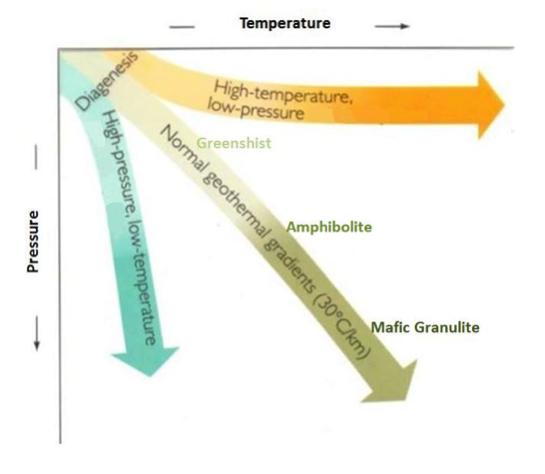
Figure 1: Pressure-Temperature diagram (P-T diagram) showing various paths that rocks may undergo during metamorphism. The figure is modified from Understanding Earth Copyright 1994 W. H. Freeman and Company.
| This article uses material from the Wikipedia article Metasyntactic variable, which is released under the Creative Commons Attribution-ShareAlike 3.0 Unported License. |