Muscovite
Muscovite (also known as common mica, isinglass, or potash mica) is a hydrated phyllosilicate mineral of aluminium and potassium with formula KAl2(AlSi3O10)(F,OH)2, or (KF)2(Al2O3)3(SiO2)6(H2O). It has a highly perfect basal cleavage yielding remarkably thin laminae (sheets) which are often highly elastic. Sheets of muscovite 5 meters × 3 meters (16.5 feet × 10 feet) have been found in Nellore, India.
| Muscovite | |
|---|---|

Muscovite with albite from Doce valley, Minas Gerais, Brazil (dimensions: 6×5.3×3.9 cm)
|
|
| General | |
| Category | Phyllosilicate |
| Formula (repeating unit) |
KAl2(AlSi3O10)(F,OH)2 |
| Strunz classification | 9.EC.15 |
| Dana classification | 71.02.02a.01 |
| Crystal system | Monoclinic |
| Crystal class | Prismatic (2/m) (same H-M symbol) |
| Space group | C2/c |
| Unit cell | a = 5.199 Å, b = 9.027 Å, c = 20.106 Å, β = 95.78°; Z = 4 |
| Identification | |
| Color | White, grey, silvery |
| Crystal habit | Massive to platy |
| Twinning | Common on the [310], less common on the {001} |
| Cleavage | Perfect on the {001} |
| Fracture | Micaceous |
| Tenacity | Elastic |
| Mohs scale hardness | 2–2.5 parallel to {001} 4 right angle to {001} |
| Luster | Vitreous, silky, pearly |
| Streak | White |
| Diaphaneity | Transparent to translucent |
| Specific gravity | 2.76–3 |
| Optical properties | Biaxial (-) |
| Refractive index | nα = 1.552–1.576 nβ = 1.582–1.615 nγ = 1.587–1.618 |
| Birefringence | δ = 0.035 – 0.042 |
| Pleochroism | Weak when colored |
| Dispersion | r > v weak |
| Ultraviolet fluorescence | None |
| References |


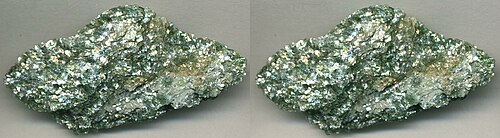
Muscovite has a Mohs hardness of 2–2.25 parallel to the [001] face, 4 perpendicular to the [001] and a specific gravity of 2.76–3. It can be colorless or tinted through grays, browns, greens, yellows, or (rarely) violet or red, and can be transparent or translucent. It is anisotropic and has high birefringence. Its crystal system is monoclinic. The green, chromium-rich variety is called fuchsite; mariposite is also a chromium-rich type of muscovite.
Muscovite is the most common mica, found in granites, pegmatites, gneisses, and schists, and as a contact metamorphic rock or as a secondary mineral resulting from the alteration of topaz, feldspar, kyanite, etc. It is characteristic of peraluminous rock, in which the content of aluminum is relatively high. In pegmatites, it is often found in immense sheets that are commercially valuable. Muscovite is in demand for the manufacture of fireproofing and insulating materials and to some extent as a lubricant.
The name muscovite comes from Muscovy-glass, a name given to the mineral in Elizabethan England due to its use in medieval Russia (Muscovy) as a cheaper alternative to glass in windows. This usage became widely known in England during the sixteenth century with its first mention appearing in letters by George Turberville, the secretary of England's ambassador to the Muscovite tsar Ivan the Terrible, in 1568.
|
||
|
||
|
||
|
||
|
||
| Small specimen of Muscovite (fuchsite) from Brazil. |
 )
) )
)
| This article uses material from the Wikipedia article Metasyntactic variable, which is released under the Creative Commons Attribution-ShareAlike 3.0 Unported License. |