Hornblende
Hornblende is a complex inosilicate series of minerals (ferrohornblende – magnesiohornblende). It is not a recognized mineral in its own right, but the name is used as a general or field term, to refer to a dark amphibole.
| Hornblende | |
|---|---|
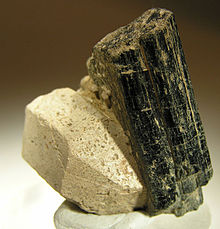
Hornblende crystal (dark green) about 35 mm long, with apatite (white)
|
|
| General | |
| Category | Silicate mineral |
| Formula (repeating unit) |
Ca 2(Mg,Fe,Al) 5(Al,Si) 8O 22(OH) 2 |
| Crystal system | Monoclinic |
| Space group | C2/m |
| Identification | |
| Color | Black to dark green or brown |
| Crystal habit | Hexagonal/granular |
| Cleavage | Imperfect at 56° and 124° |
| Fracture | Uneven |
| Mohs scale hardness | 5–6 |
| Luster | Vitreous to dull |
| Streak | Pale gray, gray-white, white, colorless |
| Specific gravity | 2.9 |
| Pleochroism | Strong |
| References |
The general formula is (Ca,Na)
2-3(Mg,Fe,Al)
5(Al,Si)
8O
22(OH,F)
2.
Compositional variances
Some metals vary in their occurrence and magnitude:
- Manganese and titanium are often present.
- Sodium and potassium are often present and fluorine often substitutes for the hydroxyl in the crystalline structure.
Physical properties
Hornblende has a hardness of 5–6, a specific gravity of 2.9–3.4 and is typically an opaque green, greenish-brown, brown or black color.
Its cleavage angles are at 56 and 124 degrees. It is most often confused with various pyroxene minerals and biotite mica, which are black and can be found in granite and in charnockite.
Occurrence
Hornblende is a common constituent of many igneous and metamorphic rocks such as granite, syenite, diorite, gabbro, basalt, andesite, gneiss, and schist.
It is the principal mineral of amphibolites. Very dark brown to black hornblendes that contain titanium are ordinarily called basaltic hornblende, from the fact that they are usually a constituent of basalt and related rocks. Hornblende alters easily to chlorite and epidote.
A rare variety of hornblende contains less than 5% of iron oxide, is gray to white in color, and is named edenite from its locality in Edenville, Orange County, New York.
Other minerals in the hornblende series include:
- pargasite
- hastingsite
- tschermakite
- edenite
Etymology
The word hornblende is derived from the German horn and blenden, to 'deceive' in allusion to its similarity in appearance to metal-bearing ore minerals.
| This article uses material from the Wikipedia article Metasyntactic variable, which is released under the Creative Commons Attribution-ShareAlike 3.0 Unported License. |